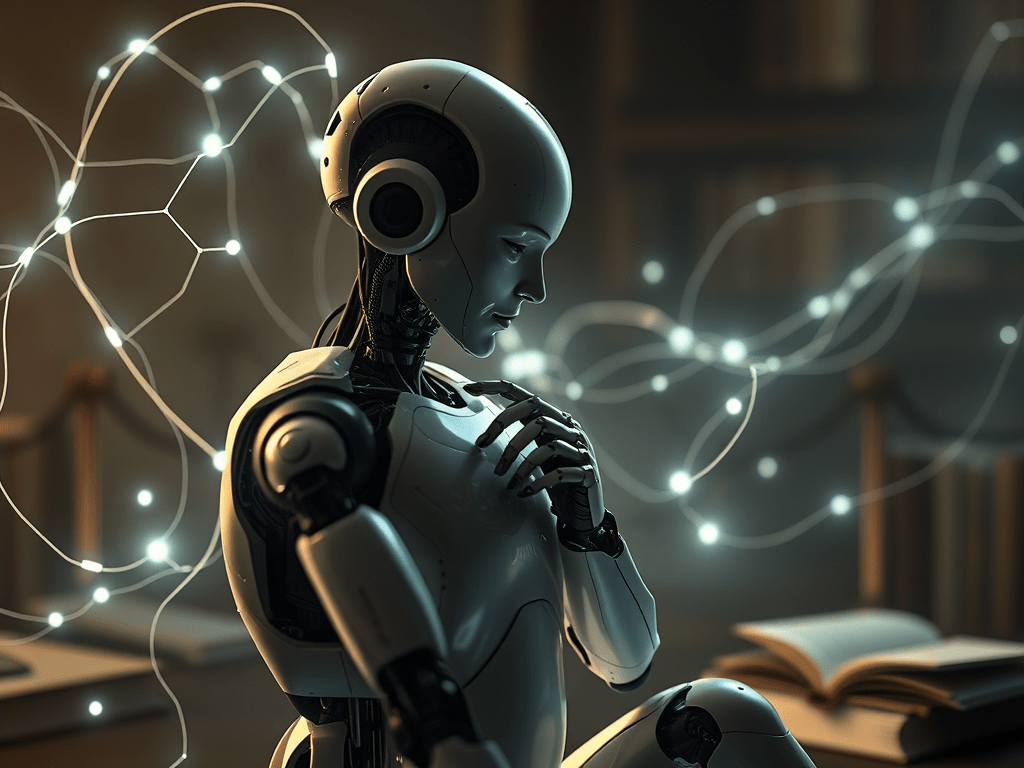
Introduction
Artificial intelligence (AI) is not just a technological advancement; it also raises profound philosophical questions about consciousness, ethics, and the nature of intelligence. As AI systems become increasingly sophisticated, they challenge long-held philosophical ideas about human cognition, autonomy, and moral responsibility. This article explores how AI intersects with key philosophical themes.
1. The Nature of Intelligence
One of the central debates in philosophy and AI concerns the nature of intelligence itself:
- Human vs. Machine Intelligence: Can AI ever truly replicate human reasoning, or does it merely simulate intelligence?
- The Turing Test: Proposed by Alan Turing, this test measures a machine’s ability to exhibit human-like conversation, raising questions about what constitutes true intelligence.
- Strong AI vs. Weak AI: Strong AI suggests machines can develop self-awareness, while Weak AI argues they are only tools that mimic cognition.
2. Ethics of AI
The rapid deployment of AI systems brings ethical concerns that philosophers and policymakers must address:
- Moral Responsibility: Who is accountable when AI systems cause harm—the developer, the user, or the AI itself?
- Bias and Fairness: AI models often inherit biases from their training data, leading to ethical dilemmas in decision-making.
- Automation and Human Value: How does increasing automation affect human purpose and labor ethics?
3. Consciousness and AI
The question of whether AI can possess consciousness is one of the most intriguing philosophical challenges:
- Chinese Room Argument: Philosopher John Searle argues that AI, no matter how sophisticated, does not truly understand language but processes symbols without meaning.
- Self-Awareness: Can AI develop self-awareness, or is consciousness a uniquely biological phenomenon?
- The Hard Problem of Consciousness: AI challenges our understanding of how subjective experiences arise in human minds.
4. AI and Decision-Making
AI plays a growing role in governance, law, and ethics:
- Autonomous Decision Systems: Should AI make decisions in law, healthcare, or warfare?
- Transparency and Explainability: Can AI models be made interpretable enough for ethical scrutiny?
- AI and Free Will: If AI can predict human behavior, does it challenge the notion of free will?
Conclusion
AI is not just a technological issue—it is a philosophical revolution that forces us to reconsider fundamental questions about intelligence, ethics, and consciousness. As AI continues to evolve, the dialogue between technology and philosophy will become increasingly critical in shaping its role in human society. Philosophers, scientists, and policymakers must collaborate to navigate the ethical and existential implications of AI.
 Chat GPT Scholar
Leave a comment